Bedtime Stories, Braille Homework, and the Art of the Eye-Roll: Blind Parents Are Doing It All
The Question She Gets at Every Playground
Melissa Torres, a blind mom of two in Columbus, Ohio, has a stock answer for the stranger who inevitably asks, "And you're watching them... alone?"
"I say, 'Yes, that's how parenting works,'" she laughs. "Then I offer to hold their coffee while they chase their own kid. That usually ends it."
Torres is one of an estimated 4.5 million American parents with vision loss, according to the American Foundation for the Blind. And like most of them, she's tired of being treated as a research question rather than a parent. Because the research, for what it's worth, is settled: study after study finds that children of blind parents develop normally — often with stronger verbal skills and more flexible problem-solving — when their parents have the right support.
The obstacle was never the parents. It's everyone else's imagination.
How Dinner Actually Gets Made
Ask blind parents how they run a household and the answers are refreshingly unromantic: routine, labels, and a lot of technology most sighted families never bother to learn.
- Labeling everything. Rubber bands on shampoo bottles, a pen of raised dots on spice jars, a braille labeler for the pantry. One dad in Portland describes his system as "the world's lowest-tech smart home."
- A pair of AirPods and a lot of listening. Screenshot-reading apps and AI describers can turn a school permission slip into speech in seconds. Parents describe the overnight shift from waiting on a helpful neighbor to handling paperwork in real time.
- The buddy system, inverted. Many parents of school-age kids rely on other parents' group texts — read aloud by their screen readers — to stay ahead of spirit week and last-minute schedule changes.
- **Old-fashioned memory, supercharged." "Sighted parents lean on their eyes," Torres says. "I lean on knowing my kid. I can tell which fever is a 'stay home' fever by the sound of it."
Homework help is the flashpoint for a lot of anxiety from expecting parents — and the place where reality disappoints the doubters. Math worksheets get photographed and read aloud. Spelling tests run on flashcard apps with audio. One father in Georgia jokes that his seventh-grader's essay feedback got sharper after he started listening to drafts instead of skimming them. "Screen readers don't skim," he says. "Every word gets my full attention. Maybe that's the lesson."
When the Courtroom Doesn't Believe You
Here's the part of this story that isn't funny. In family courts across the country, blindness is still used — explicitly or by implication — as evidence of unfitness. The National Federation of the Blind's Parents' Division has tracked cases where custody or visitation was restricted solely because a parent is blind, in direct violation of the Americans with Disabilities Act.
The landmark case came in 2013, when the Justice Department intervened on behalf of Carrie Drew, a Kansas mother whose newborn was removed from her custody, in part, by a hospital intake worker's judgment about her blindness. A federal jury sided with Drew. Congress followed with amendments to the ADA affirming that disability alone can never justify removing a child.
Yet advocates say subtler versions persist: evaluators who recommend "extra oversight" for no reason, judges who've never met a blind parent, caseworkers who confuse adaptive parenting with risk. The NFB maintains a know-your-rights toolkit and a network of attorneys for parents facing these fights.
"The law is on our side," says one Texas mom who fought a two-year custody battle. "But you shouldn't need a federal statute to be trusted with your own toddler."
The Wins Nobody Writes Headlines About
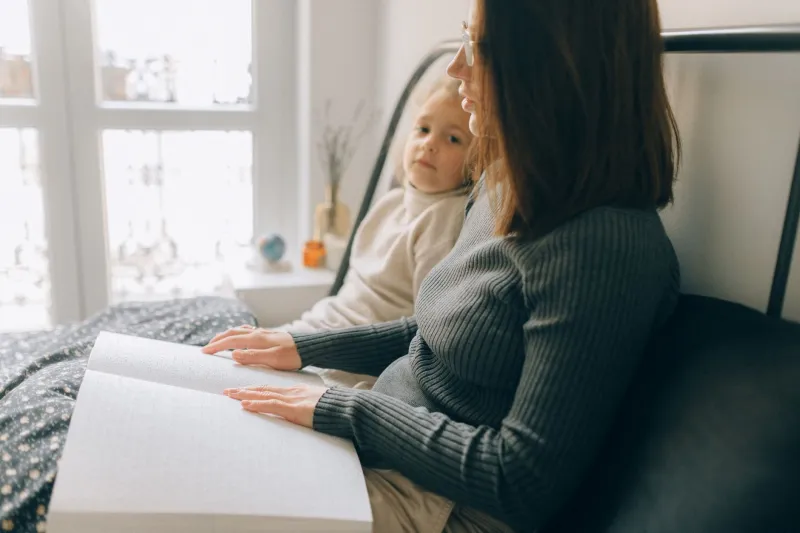
For every courtroom story, there are a hundred ordinary victories. The dad who taught his daughter to ride a bike by running alongside, hand on the seat, exactly like every other dad. The mom who reads "Harry Potter" in braille while her son follows the print, a two-format family book club. The teenager who admits — under duress, off the record — that having a mom who hears everything is "kind of an unfair advantage."
And the adaptations get passed down. Kids of blind parents become expert describers, confident travelers, casual experts on access. One 11-year-old in Denver cheerfully reported that she "narrates movies for Mom" and considers herself "basically a professional."
If You're Expecting: A Starter Resource Guide
For blind and low-vision parents-to-be, the playbook already exists — you just have to know where to look:
- National Federation of the Blind — Parents and Blind Children Division: peer mentoring, a listserv that's been answering new-parent questions for decades, and custody-rights resources.
- American Printing House for the House (APH) and National Braille Press: accessible parenting books, from newborn care manuals to kids' readers in braille.
- Hadley: free, remote workshops on daily living skills — including ones taught by parents, for parents.
- State Vocational Rehabilitation agencies: can fund adaptive equipment for parenting tasks, from tactile thermometers to talking scales.
- Be My Eyes and Aira: free or low-cost visual assistance apps for those moments when you just need a second pair of eyes.
- Blind Parents' networks on Facebook and Reddit: unfiltered, practical, and faster than any professional.
The through-line from every parent we spoke with? Nobody needed saving. They needed information, community, and the benefit of the doubt.
"People picture what I can't do," Torres says, as her kids barrel through the kitchen behind her. "I'd love it if, just once, they pictured what I'm actually doing. Which right now is homework, dinner, and finding a lost sneaker. You know. Parenting."