Scrubs, Stethoscope, No Problem: Meet the Blind Nurses Rewriting the Job Description
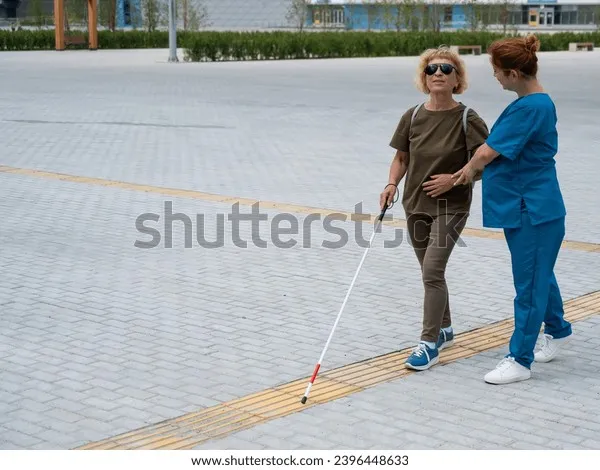
Photo: blind nurse working in hospital hallway with white cane and scrubs, via www.shutterstock.com
The night shift at a skilled nursing facility outside Columbus doesn't slow down for anyone. Call lights ping. A resident in Room 214 needs a blood pressure recheck. Another fell asleep with her hearing aids out. And moving through all of it is a licensed practical nurse named Dana, whose fingers are doing half the diagnostic work her colleagues do with their eyes.
She feels the difference between a taut, distended abdomen and a relaxed one. She reads medication labels with a handheld scanner that chirps dosages into her ear. She counts respirations by resting a hand lightly on a resident's shoulder — a technique, she'll tell you with a grin, that tends to get more accurate numbers than standing there staring at a stopwatch.
Dana is one of a small but growing number of blind and low-vision healthcare workers in the United States, and her existence comes as a genuine shock to plenty of patients, hiring managers, and even nursing school admissions officers. Which is exactly the problem.
The Job Nobody Thinks You Can Do
Nursing sits at the top of the list of careers people assume require sight. Ask around and you'll hear it: How could you possibly draw blood? How would you spot a rash? How do you read a monitor?
The answers are less mysterious than people think. Blood draws rely mostly on touch — that's why experienced nurses close in on a vein by feel, not by staring. Rashes can be assessed through description from the patient, tactile texture, and photographs reviewed with a colleague or screen reader. Monitors talk, if hospitals bother to buy ones that do. And the truth is that a huge share of nursing is listening, palpating, documenting, and communicating — skills where blind professionals often arrive with a head start.
Research on clinical performance tells a consistent story: blind and low-vision medical professionals who complete training perform on par with their sighted peers. The bottleneck isn't competence. It's admission.
The Gate at the Front Door
Here's where the story gets less feel-good. Nursing programs in most states still route applicants through boards of nursing and technical standards written decades ago, many of which explicitly require the ability to "observe" and "discern" — language that functionally screens out blind candidates before anyone evaluates whether they can actually do the work.
A handful of programs have modernized. Some universities have graduated blind nursing students who used accessible simulators, tactile sphygmomanometers, and creative clinical accommodations. But these remain exceptions, scattered across a patchwork of state rules. A qualified candidate in one state can enroll; the identical candidate two borders over gets a form letter.
The result is a workforce shortage colliding with a talent surplus. Hospitals nationwide are begging for nurses, offering signing bonuses and travel stipends — while turning away people who are ready, trained, and eager, purely because of outdated paperwork.
What Employers Learn
Talk to the supervisors who do hire blind healthcare workers and a pattern emerges. The first week is spent answering questions. The second week, the questions stop. By the third, the blind aide on the floor is the one everyone asks to double-check a tricky assessment, because her attention to tactile detail and her habit of verbalizing everything makes her a built-in safety net.
There's a lesson in that. Accessibility in healthcare settings — talking monitors, labeled supplies, screen-reader-compatible charting software — doesn't just benefit blind staff. It reduces medication errors, speeds up handoffs, and makes workplaces better for everyone aging into low vision on the job, which is a lot more nurses than anyone admits.
What Has to Change
Fixing this isn't complicated, but it does require intent:
- Rewrite technical standards to focus on essential functions rather than sensory checkboxes.
- Fund accessible nursing education, from tactile anatomy models to accessible simulation labs.
- Modernize state board requirements so a qualified nurse is a qualified nurse in all fifty states.
- Publicize the success stories, because assumptions die fastest when people meet the professionals they were sure couldn't exist.
Dana finishes her shift at seven in the morning. She clocks out, cane in hand, past a bulletin board covered in thank-you cards from residents. One of them, scrawled in shaky handwriting, says simply: "You noticed what nobody else did."
She did. With her fingers. Like she always does.
The question left isn't whether blind Americans can do this work. It's how long the system will keep pretending they can't.